Architecture
Overview
Conversational Agents in IB-X combine artificial intelligence, enterprise knowledge, workflow automation, and communication channels to deliver intelligent conversational experiences.
A Conversational Agent receives requests from users, understands the intent of the conversation, retrieves relevant information, executes business actions when required, and generates contextual responses.
High-Level Architecture
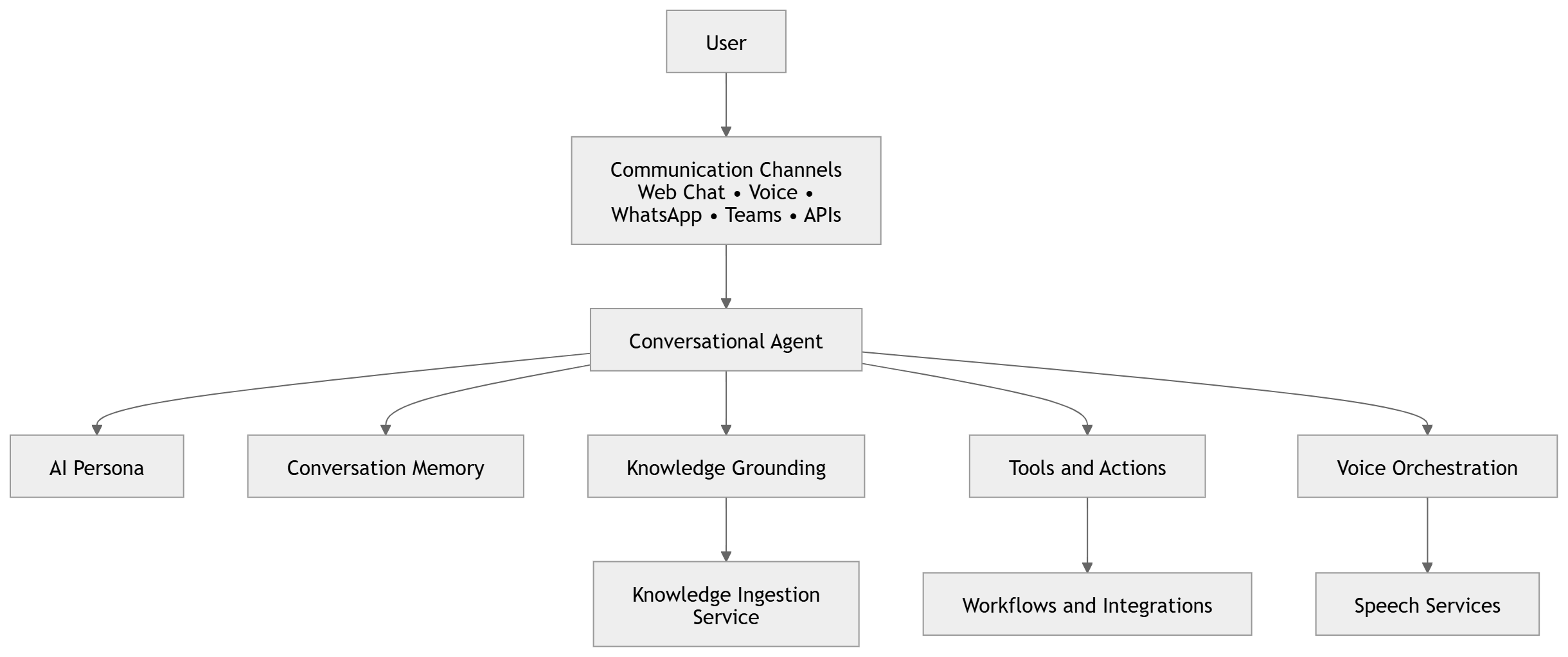
Core Components
Conversational Agent
The Conversational Agent is the central component responsible for managing conversations.
It coordinates interactions between language models, knowledge sources, workflow automation, and external systems to generate intelligent responses and perform actions on behalf of users.
AI Persona
The AI Persona defines how the agent behaves during conversations.
It controls characteristics such as:
- Role and responsibilities
- Communication style
- Tone and personality
- Response guidelines
- Behavioral restrictions
- Business-specific instructions
The persona helps ensure that responses remain consistent and aligned with organizational requirements.
Conversation Memory
Conversation Memory maintains conversational context across user interactions.
This enables the agent to:
- Understand follow-up questions
- Retain relevant context
- Maintain natural conversations
- Reduce repetitive user input
Memory may be maintained for the duration of a session or according to platform-specific retention policies.
Knowledge Grounding
Knowledge Grounding enables the agent to retrieve information from enterprise knowledge sources.
When answering questions, the agent can search and retrieve relevant information from content that has been ingested through the Knowledge Ingestion Service.
Knowledge sources may include:
- Websites
- Documents
- Knowledge bases
- Product documentation
- Internal business content
Grounding helps improve response accuracy and reduces the likelihood of generating unsupported information.
Tools and Actions
Tools allow Conversational Agents to perform business operations in addition to answering questions.
A tool typically invokes a workflow, integration, or business process.
Examples include:
- Creating tickets
- Retrieving customer information
- Processing approvals
- Creating invoices
- Updating records in business applications
- Executing enterprise workflows
This capability enables Conversational Agents to move beyond information retrieval and actively perform work.
Workflow Automation
Conversational Agents can integrate with IB-X workflow automation capabilities.
Workflows provide:
- Business process orchestration
- Human-in-the-loop interactions
- System integrations
- Data processing
- Enterprise automation
Agents can invoke workflows as part of a conversation whenever user requests require business actions.
Voice Services
Voice Services enable real-time voice-based interactions.
These services typically include:
- Speech-to-Text (STT)
- Text-to-Speech (TTS)
Voice capabilities allow the same Conversational Agent to operate as both a chat agent and a voice agent.
Communication Channels
Communication Channels provide the interface through which users interact with the Conversational Agent.
Currently, IB-X supports conversational interactions through the built-in web chat experience.
Additional channels such as voice, messaging platforms, and other communication interfaces may be supported in future releases.
The Conversational Agent is designed to provide a consistent conversational experience across supported channels.
Request Processing Flow
A typical conversation follows the sequence below:
- A user sends a message through a communication channel.
- The Conversational Agent receives and analyzes the request.
- The AI Persona provides behavioral guidance.
- Relevant conversation context is retrieved.
- The agent determines whether knowledge retrieval or tool execution is required.
- Knowledge sources, workflows, or integrations are invoked as needed.
- The language model generates a response using the available context.
- The response is returned to the user through the originating channel.
Enterprise Benefits
The architecture enables organizations to:
- Deliver consistent conversational experiences
- Leverage enterprise knowledge effectively
- Automate business operations through conversations
- Support both chat and voice interactions
- Integrate with existing systems and processes
- Scale conversational experiences across multiple channels