Introduction
Overview
The IntelliBuddies AI Command Center is a web-based management console for designing, configuring, executing, and monitoring automation across your organization. It acts as the central control plane for automation agents, users, integrations, schedules, and operational visibility.
The AI Command Center connects:
- Automation designers and administrators
- Human users participating in workflows
- Client tools used for desktop automation
- External systems and AI services through integrations
First-Time Configuration (Configuration Wizard)
To simplify installation and ensure a clean, guided setup experience, the AI Command Center now uses a first-time configuration wizard.
What this means
- Configuration no longer happens during installation.
- The first person accessing the AI Command Center after installation is guided through an initial setup wizard.
- A System Administrator typically performs this setup.
When it appears
- The configuration wizard is displayed automatically the first time the AI Command Center is opened.
- Users cannot log in until this configuration is completed.
What the wizard configures
The wizard guides you through:
- Database selection and configuration
- Creation of the initial Administrator account
- Tenant initialization
- Optional SMTP and regional settings
Once completed, the AI Command Center becomes fully operational.
📘 Refer to: AI Command Center Configuration Guide
Accessing the AI Command Center
- Open a supported web browser.
- Navigate to the AI Command Center URL.
- After configuration is complete, the Login page is displayed.
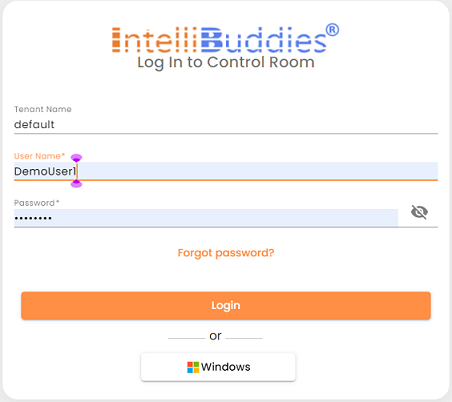
Tenant-Based Login
The AI Command Center is multi-tenant.
Tenant Name
- The Tenant Name identifies the organization or tenant you are logging into.
- The default tenant is set to
defaultunless configured otherwise. - Enter the appropriate tenant name before logging in.
Authentication Methods
The AI Command Center supports multiple authentication providers, which may vary by deployment and configuration.
Supported authentication types
- Basic Authentication (local users)
- LDAP Authentication (Microsoft Active Directory or compatible LDAP providers)
- Azure Active Directory Authentication
- Additional authentication providers may be supported in future releases
The available login options depend on what your administrator has configured.
Logging in with Basic Authentication
Basic Authentication is always available for locally created users.
Steps:
- Enter User Name
- Enter Password
- Click Login
This method works regardless of whether LDAP or Azure AD authentication is configured.
Logging in with LDAP or Azure AD (Manual Login)
When LDAP or Azure AD authentication is enabled:
- Enter your directory User Name
- Enter your directory Password
- Click Login
User accounts for these authentication types are not created manually in the AI Command Center. They are automatically synchronized from the configured identity provider.
Single Sign-On (SSO)
If SSO is enabled for LDAP or Azure AD:
- Click the corresponding SSO button on the login page (for example, Windows).
- The system authenticates you using your current session credentials.
SSO requires the authentication provider to be configured with SSO enabled by an administrator.
After Successful Login
Once authenticated, you are redirected to the AI Command Center dashboard. The features and pages you can access depend on:
- Your assigned roles
- Group memberships
- Permissions granted within the tenant
Key Capabilities of AI Command Center
Administration
Manage platform configuration and governance:
- Users
- Groups
- Roles and Permissions
- Licenses and Applications
- Feature Management
- Authentication Providers
- Delegations
- Email Monitoring
- Audit Logs
- Recycle Bin
- Import / Export
- Integration Gateway Usage
- Server Logs
Automation Management
Design, deploy, and execute automation agents:
RPA & Desktop Automation
Configure and manage client-side automation:
Monitoring & Operations
Track execution, jobs, and system health:
Assets & Shared Resources
Summary
The AI Command Center provides a unified, secure, and scalable platform to manage automation across users, systems, and AI services. With the introduction of the first-time configuration wizard, setup is now more straightforward, more guided, and better aligned with enterprise deployment needs.