AWS EKS Deployment Overview
Deploy the IB-X AI Command Center (AICC) and its associated services in your AWS environment using Amazon Elastic Kubernetes Service (EKS). IntelliBuddies supplies prebuilt container images and a Helm deployment package. Your Infrastructure and DevOps teams provision and operate the AWS infrastructure and deploy approved images from Amazon Elastic Container Registry (ECR).
Deployment architecture
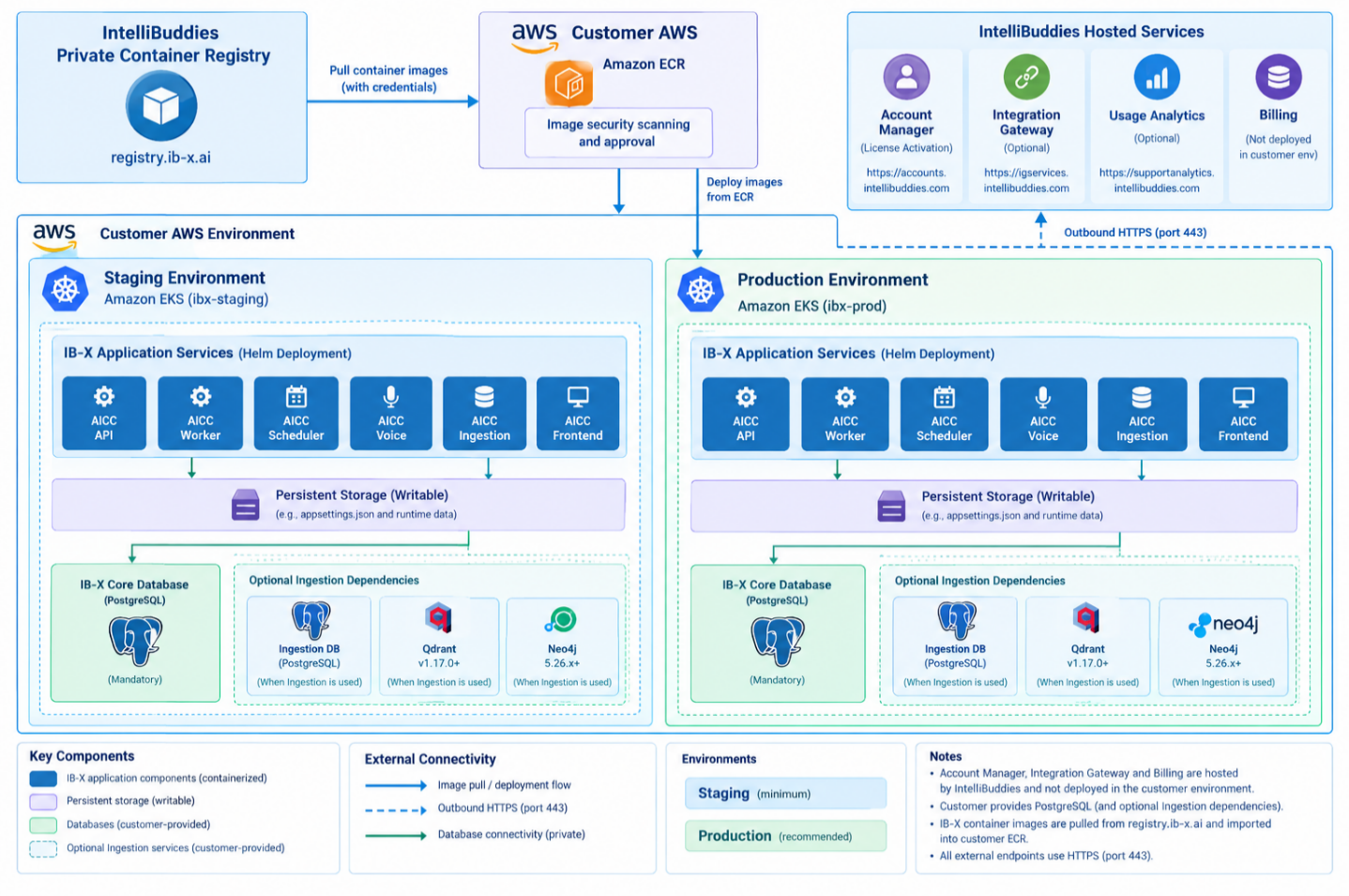
Maintain separate Staging and Production environments. You may use independent EKS clusters or separate namespaces on a shared cluster according to your infrastructure standards. Isolate application configuration, secrets, databases, and persistent storage for each environment.
Application components
The deployment package includes the following services. The supplied configuration uses one replica per service; additional scaling and high availability require separate validation.
| Component | Kubernetes resource | Default replicas | Container port |
|---|---|---|---|
| AICC API | Deployment | 1 | 8080 |
| AICC Worker | Deployment | 1 | 8080 |
| AICC Scheduler | Deployment | 1 | 8080 |
| AICC Voice | Deployment | 1 | 8080 |
| AICC Ingestion | Deployment | 1 | 8080 |
| AICC Frontend | Deployment | 1 | 8080 |
Supporting resources provide networking, configuration, secrets, and persistent storage.
Scope
This guide covers the customer-hosted AI Command Center platform. Requirements for customer-specific solutions and their integrations are documented separately.
Local Agents that perform desktop or UI automation require a separate Windows environment with Process Designer and Smart Station. These Windows components are outside the EKS deployment and are required only when Local Agent capabilities are used.
Responsibilities
| Activity | IntelliBuddies | Customer Infrastructure and DevOps |
|---|---|---|
| Container images and release references | Provide and maintain | Import into ECR, scan, and approve |
| Helm deployment package | Provide package and configuration guidance | Deploy with agreed support |
| EKS compute and networking | Define application prerequisites | Provision, secure, and operate |
| Databases and optional ingestion dependencies | Provide connectivity requirements | Provision, back up, and maintain |
| Persistent storage | Define mount and access requirements | Provision and maintain |
| DNS, ingress, TLS, and outbound connectivity | Identify application requirements | Configure and manage |
| License activation | Provide licensing and activation guidance | Enable connectivity and coordinate activation |
| Deployment verification | Support application validation | Validate infrastructure and coordinate acceptance |
Next steps
- Review the infrastructure prerequisites.
- Follow the deployment workflow.
- Complete the deployment verification checklist.
- Establish enterprise operating procedures before opening Production.